

“Shredded Art
Tory Cowles dances between painting and sculpture & Rosa Inés Vera turns folkloric. Also: Five under 35 & Keith Krueger; Chris Chernow, Elizabeth Curren, & Carolee Jakes; & nearly 100 photographers
DEC 31
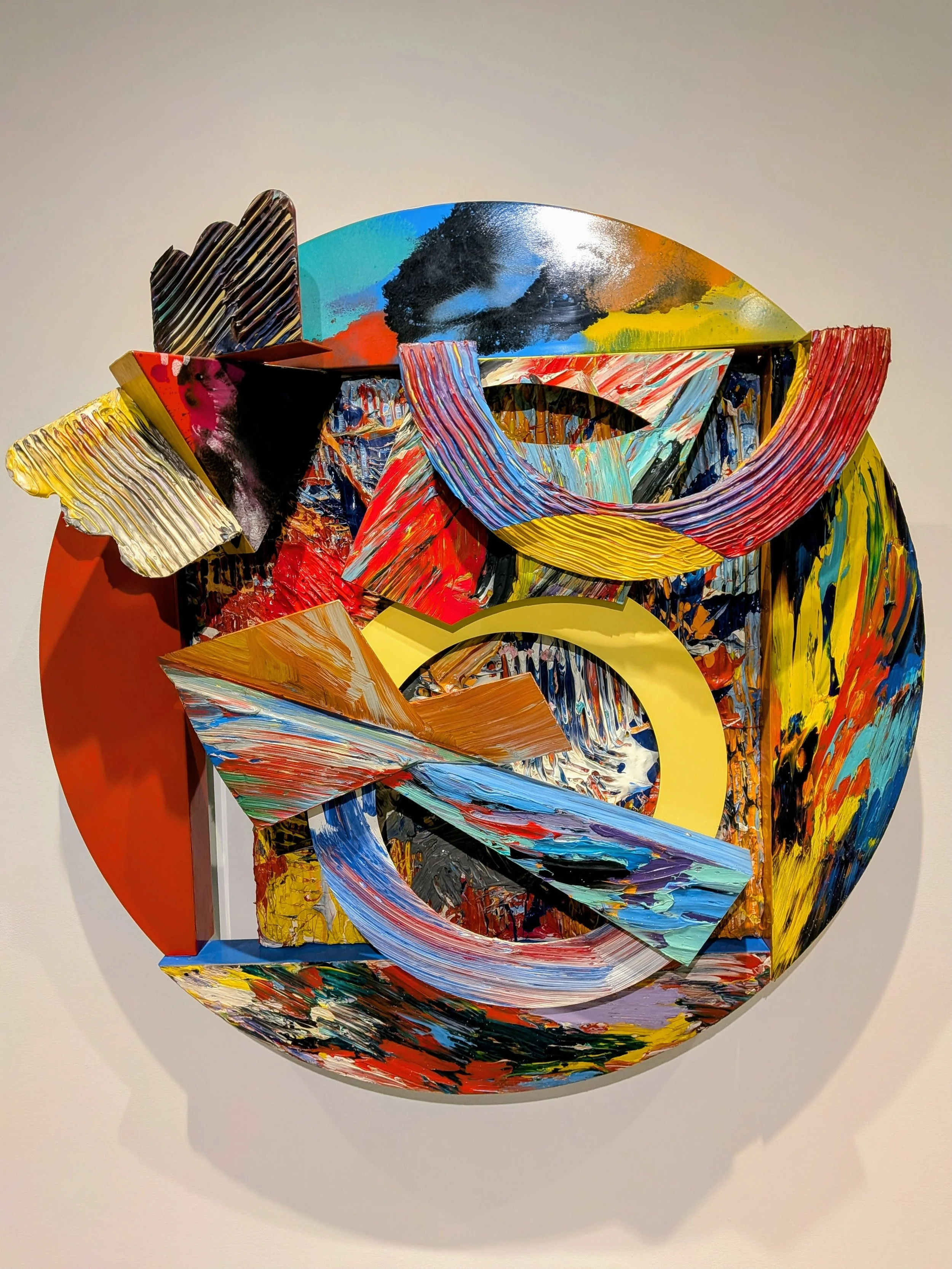
Tory Cowles, “Explosion on the Cabin John Bridge” (photo by Mark Jenkins)
THE NARROW THREAD THAT LINKS THE WORK OF Tory Cowles and Rosa Inés Vera is a shared interest in decorative traditions. The two local artists, who have adjacent shows at Touchstone Gallery, mostly explore territories that are far distant from each other’s. The former’s “Serendipity: A Dance Between Painting and Sculpture” juxtaposes neo-abstract-expressionist canvases with found-object assemblages, while the latter’s “Resilencia” consists of portraits, generally archetypal rather than specific, of Latin-American women.
The most prominent pieces in Cowles’s show are four large abstract paintings that are multi-colored but dominated by the hues of sunlight and night: yellow and black. These pictures aren’t exactly sculptural, but they do have abundant 3D features: thick impasto, heavily worked surfaces, craggy textures, and collaged bits. So it seems apt that the artist would deconstruct other of her paintings into mobiles, folded eccentrically and suspended in midair.
Perhaps the most successful of Cowles’s hybrids is “Explosion on the Cabin John Bridge,” a shredded black truck tire that’s painted yellow and orange and hung on the wall. Roughly circular, “Explosion” is a particularly dynamic sort of action painting, and echoes the color schemes of the other pictures.
Several of the found-object collages arrange, in clear plastic boxes, such lifeless natural objects as dried flowers and dead insects, as well as a shard of snakeskin and the desiccated remains of a frog. Near these haphazard memento mori are three wall pieces based on pressed-tin ceiling tiles, whose embossed patterns the artist partly obscures with fabric and beads. While Cowles’s approach is anything but tidy, in appropriating such objects she winks appreciatively at the decorative arts.
Vera’s relationship to ornamentation is simpler. Floral motifs and fabric-style designs appear both on and around the women she paints in a flat, vividly colorful style. Several paintings, notably “Unidad (Retablo),” emulate the look and design of textiles. (A retablo, by the way, is a devotional painting that usually draws from Roman Catholic imagery and is executed in a folkloric style.)
Many of the other figures are faceless, loosely rendered, and seemingly in motion. As suggested by the six different versions of “Las Comrades,” the women are frequently grouped together, as if engaged in some kind of collective action. Even when their faces have no features, Vera’s subjects conjure a sense of community.
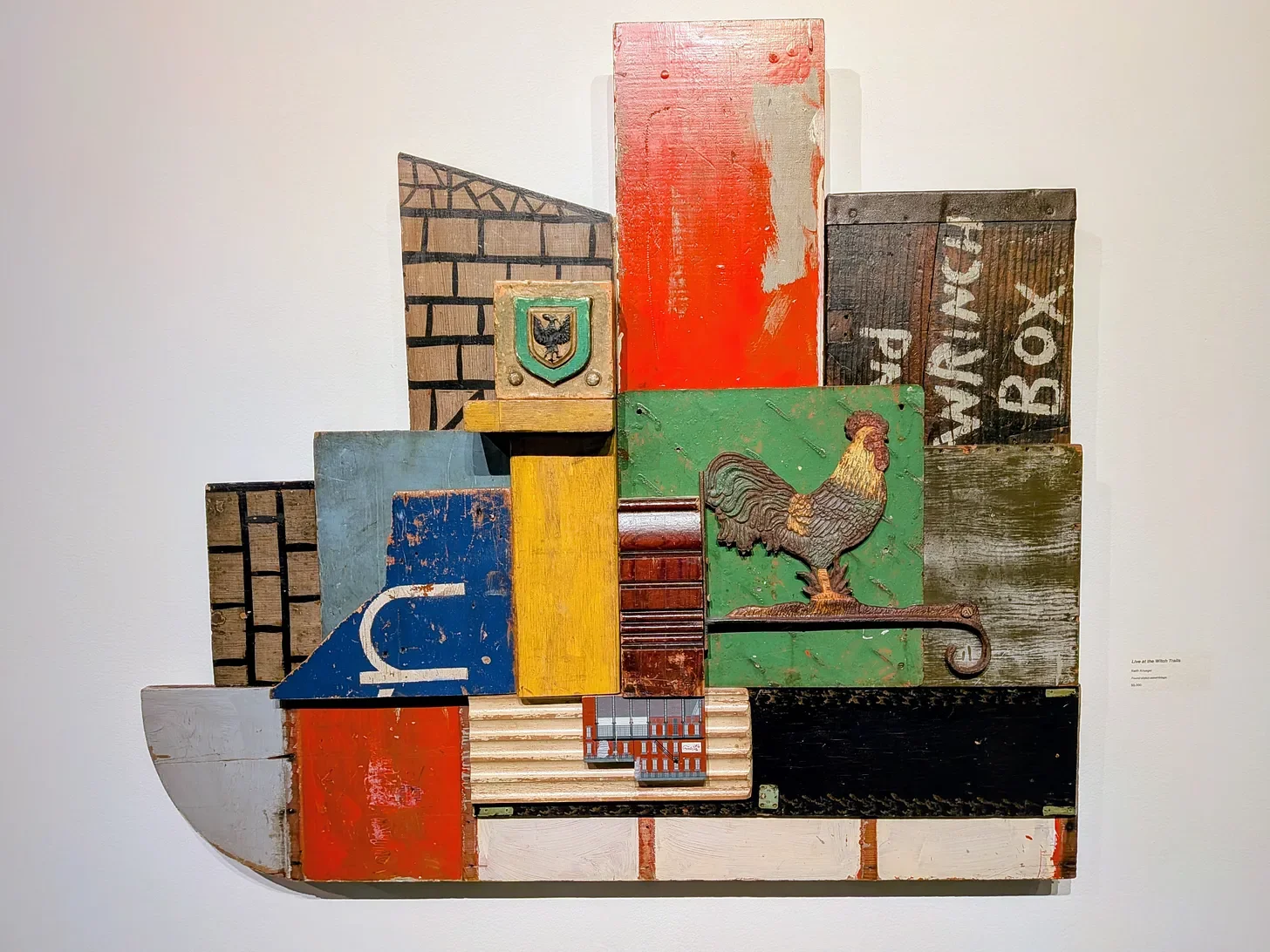
Keith Krueger, “Live at the Witch Trials” (photo by Mark Jenkins)
A STRONG PHYSICAL PRESENCE, WHETHER ACTUAL OR SIMULATED, characterizes much of the work in “Hits Different: 5 Under 35,” a Brentwood Arts Exchange showcase of emerging local artists. Several of the contributors, all selected by curator Emily Fussner, blur the border between two- and three-dimensional media. Even MK Bailey, a nearly traditional painter, contrasts flatness and depth in such sweeping pictures as “Dark Woods II,” in which the style becomes more abstract in the composition’s hindmost regions.
Where Bailey draws from centuries-old landscape and mythological canvases, Marisa Stratton takes her subjects from smartphone snapshots. Yet her paintings and drawings are anything but photorealist; they’re loosely rendered, as if in an attempt to undermine machine-generated regularity with free gestures. Bodies feature messily in Madyha Leghari’s drypoint etchings, which include images of childbirth and torsos connected by umbilical cords. The artist underscores the corporeality of her pictures by rendering them not on paper but on chunky slabs of pink rock salt whose color hints at skin.
Milan Warner also evokes the body with unsettling pieces like “Soft Horde,” a large wall sculpture made of intestine-like lengths of stuffed pantyhose punctuated by tufts of fake hair. Her work is harder edged, but ceramicist Ara Koh also summons thoughts of mutability with piles of stoneware strands, coiled like ribbons or tendrils, and craggy “paintings” of poured clay. They’re clearly solid, but what they freeze is a vision of liquidity and flux.
The materials lumped into Keith Krueger’s combines are familiar, but the suburban-Maryland artist clearly intends for them to fuse into something both more and other than the sum of their parts. One way he does this to title the 3D collages in his “What You See Is What You Get,” also at Brentwood Arts Exchange, after songs by rock performers -- whether as mainstream as the Rolling Stones (”She’s a Rainbow”) or as cultic as the Fall (”Live at the Witch Trials”). The suggestion is that these sculptures are as shapely as a tune, and have been transformed from their components into something altogether different.
The artist employs salvaged materials, most often wooden, from the insides and outsides of houses and other vintage buildings. Toys, product lids, and beverage crates are fitted neatly together, and the presence of furniture legs and house numbers accentuates the sense of domesticity. Krueger’s assemblages are idiosyncratic, but not alienating. From the remnants of yesterday’s suburban life, he’s constructed something homey.
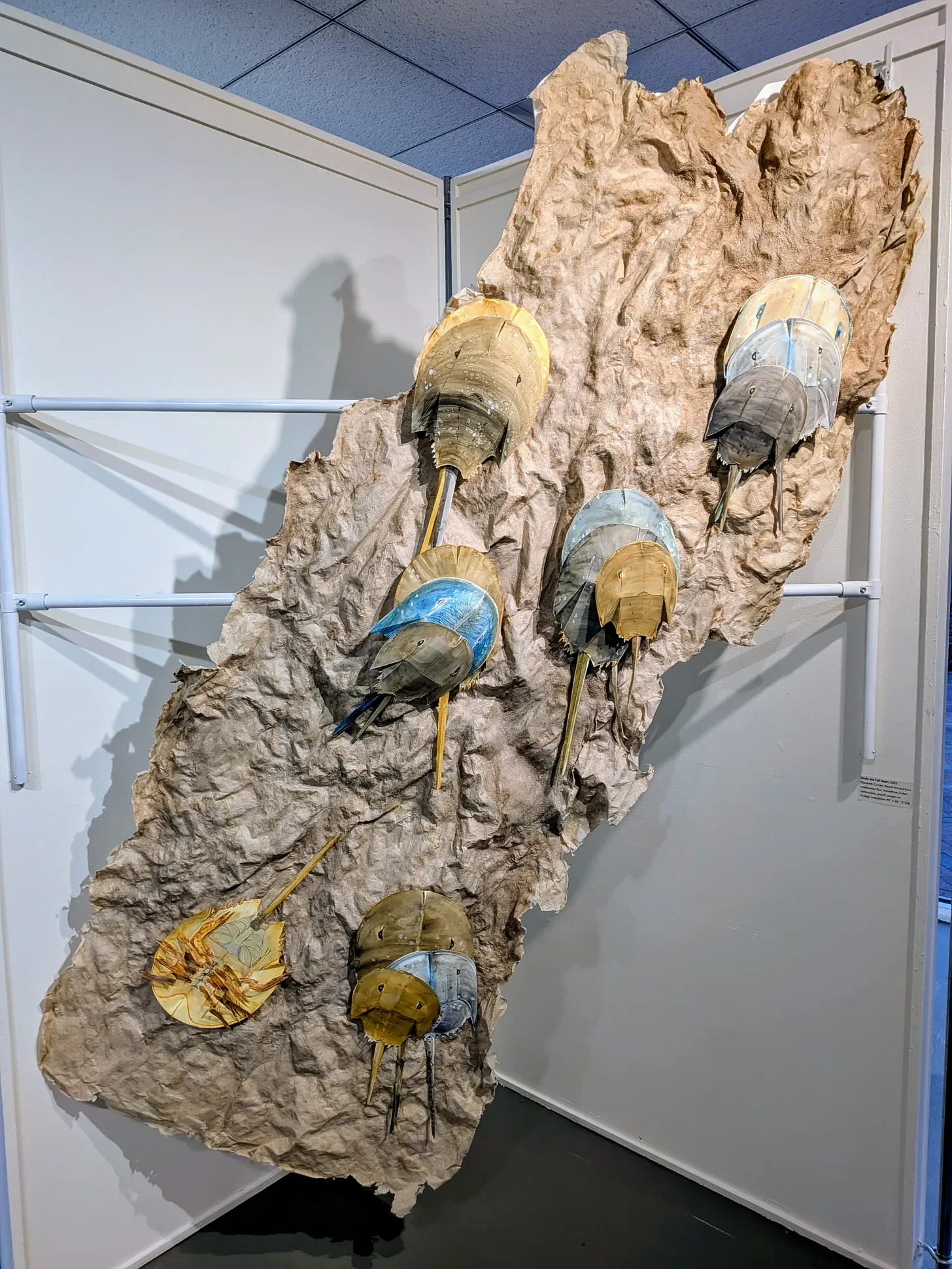
Elizabeth Curren, “Under the Full Moon” (photo by Mark Jenkins)
THE AFFINITY OF THE THREE ARTISTS now exhibiting at Gallery B may be more personal than aesthetic, but Chris Chernow, Elizabeth Curren, and Carolee Jakes did make two collaborative pieces for their diverse yet cohesive show, “What Lies Beneath.” The local artists, all members of D.C.’s Studio Gallery and fellow alumni of the Corcoran College of Art + Design, worked together on abstract painting-drawings whose swirling forms hint at organic phenomenon.
This is hardly surprising, since nature imagery is common to the other work. Curren’s creations, which range from intricate artists’s books to sculptures made largely of paper and flax, depict threatened natural wonders like glaciers and horseshoe crabs. The representations burrow through pages and scurry up walls, demonstrating how paper-based lifeforms can come very nearly to life.
If Curren’s work is the most dynamically sculptural, the artist is not the only one of the trio who expands 2D works into an additional dimension. Jakes affixes woodblock prints she deemed “imperfect” to globes hung together in a miniature solar system, and incorporates electronic parts and other manufactured items into collage-paintings. There’s an echo of Curren’s excavated tomes in a Jakes picture that’s cut open to reveal a black metal sculpture in the shape of a rooster -- a reminder of the venerable human impulse to invoke nature in technology.
While Curren and Jakes literally break through the surface, Chernow gently conjures depths with flat, earth-toned paintings. One of these portrays a blue pitcher, but Chernow’s still lifes are usually portraits of a sort. They depict near-faceless women in abstracted environments, often soft and streaky and rendered with multiple overlapping veils of similar colors. The distinction between subject and backdrop is slight and seemingly unstable. Unlike the show’s other two participants, Chernow allows only the tiniest of distances between front and back.
Mia Feuer, “Exhaust (Shabbat Candles)” (Transformer)
MAKING A PHOTOGRAPH THAT NO ONE’S MADE BEFORE was a challenge even before smartphones transformed just about everyone into a daily street photographer. So the number of striking pictures in “Photography 2025” is impressive, even if many of the entries are merely good. Juried by Washington Post critic Philip Kennicott, the Hill Center at the Old Naval Hospital exhibition includes more than a dozen exceptional images.
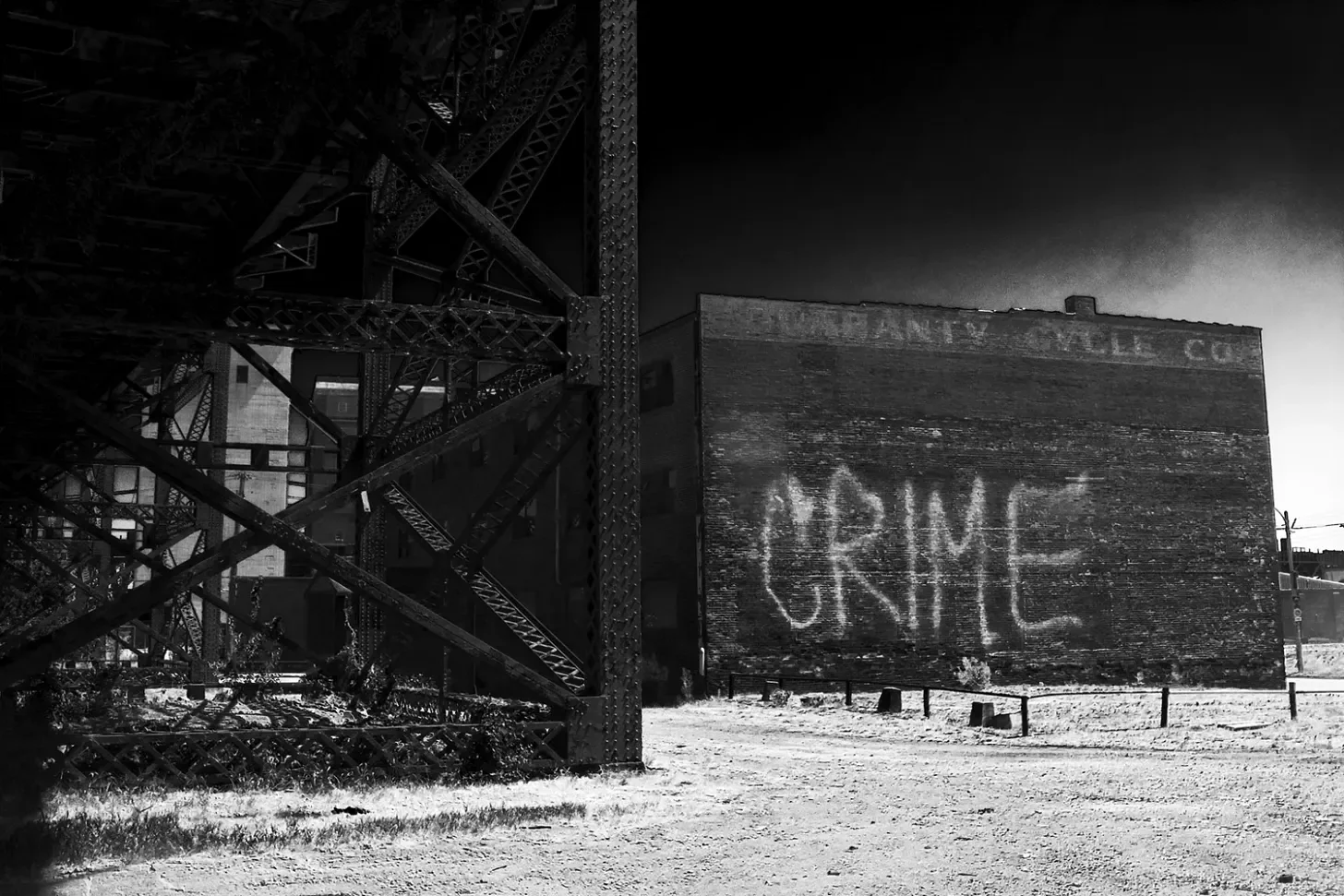
Of the approximately 90 contributors, a few offer neatly twinned sets. David Moss pairs two photos in which a man conveys beverage containers -- one guy more successfully than the other -- in contrasting directions. Less compositionally aligned but just as complementary are Michael Horsley’s two vintage black-and-white vistas of neglected buildings, one evocatively festooned with a large graffito of the word “crime.”
There are many local views, often of (or shot from) highly recognizable sites. Most involve exceptional circumstances or unusual angles, but the resulting pictures are still generally less interesting than those that portray funkier locations, notably John Valenti’s vertiginously framed, sepia-toned gaze down Georgetown’s “Exorcist steps.” Of the many out-of-town scenes, the most potent is Nan Raphael’s photo of a Guatemalan volcano whose fire smears a nearly monochromatic sky with plumes of orange.
Many of the other nature studies are more tightly focused. In two standouts, Richard Weiblinger locates stands of vibrant green grass amid a watery gray morass, and Steven Marks discerns a black cat largely hidden by colorful soft-focus foliage. Even more intimate are Paige Billin Frye’s pulpy yet precise inspections of dried flowers, Julius Kassovic’s autopsy of fallen leaves in brown and green, and Megan O’Bierne’s zoom in on the spiky landscape of starfish. (More playfully, Dan Hildt offers almost 250 cut-together closeups of tiny sidewalk splats, mostly chewed gum.)
One nature vignette, Todd Franson’s contemplation of a seed pod, can be seen as a unifying gesture. The pod’s elegant spiral complements the curved forms of the many neoclassical buildings pictured in this selection. If “Photo 2025” has a visual theme, it’s the synchronicity of manmade and natural architecture.
Tory Cowles: Serendipity: A Dance Between Painting and Sculpture
Rosa Inés Vera: Resilencia
Through Jan. 11 at Touchstone Gallery, 901 New York Ave. NW. touchstonegallery.com. 202-682-4125.
Hits Different: 5 Under 35
Keith Krueger: What You See Is What You Get
Both through Jan. 3 at Brentwood Arts Exchange, 3901 Rhode Island Ave., Brentwood. pgparks.com/facilities/brentwood-arts-exchange. 301-277-2863.
What Lies Beneath: Chris Chernow, Elizabeth Curren, Carolee Jakes
Through Jan. 4 at Gallery B, 7700 Wisconsin Ave. #E, Bethesda. bethesda.org/bethesda/gallery-b-exhibitions. 301-215-7990.
Photography 2025
Through Jan. 10 at Hill Center at the Old Naval Hospital, 921 Pennsylvania Ave. SE. 202-549-4172.”
Written by Mark Jenkins in DisCerning Eye, thank you!