

This is a poster entitled Zimbabwe: One Enemy: Imperialism (1977). The poster is printed on paper with ink, most likely screen-printed, given the time and the opacity of the ink on the paper. It consists of black, white, grey, and red ink, with the red being used to emphasize certain phrases and images. The poster grabs your attention with the red, large, and bolded text, almost being utilized as a frame that reads, “ZIMBABWE: One Enemy: Imperialism.” Through the images, the origin of the quotes, and the emphasis on imperialism, one can deduce that it is a poster that was created in resistance to the British colonization of Zimbabwe and that visual art was seen as an important element of the resistance. Sandwiched between the large text and against the black background are three rows of images, each accompanied by a caption.
The images in the first row are sketches of Cecil Rhodes and other British colonizers followed by captions that include a brief summary of Rhodes’ colonization of Zimbabwe, a quote by Cecil Rhodes on why Imperialism must be enforced, an excerpt from the British South Africa Company on the living situation of the natives, a quote by the Matabele King, Lobengula, and a quote by Amilcar Cabral defining Imperialism. Below that is a row of four images, one drawing and three photographs, each offering a deeper understanding of life under colonial rule, depicting scenes of soldiers and protests. These images are partnered with two quotes by Vladimir Lenin discussing working conditions and the economy. Finally, the third row is a large photograph printed in red ink depicting a passionate protest against Imperialism and colonization by the Zimbabwean people accompanied by a quote from Amilcar Cabral stating “Since imperialism is trying simultaneously to dominate the working class in all the advanced countries and smother the national liberation struggles in all the underdeveloped countries, then there is only one enemy against whom we are fighting.”
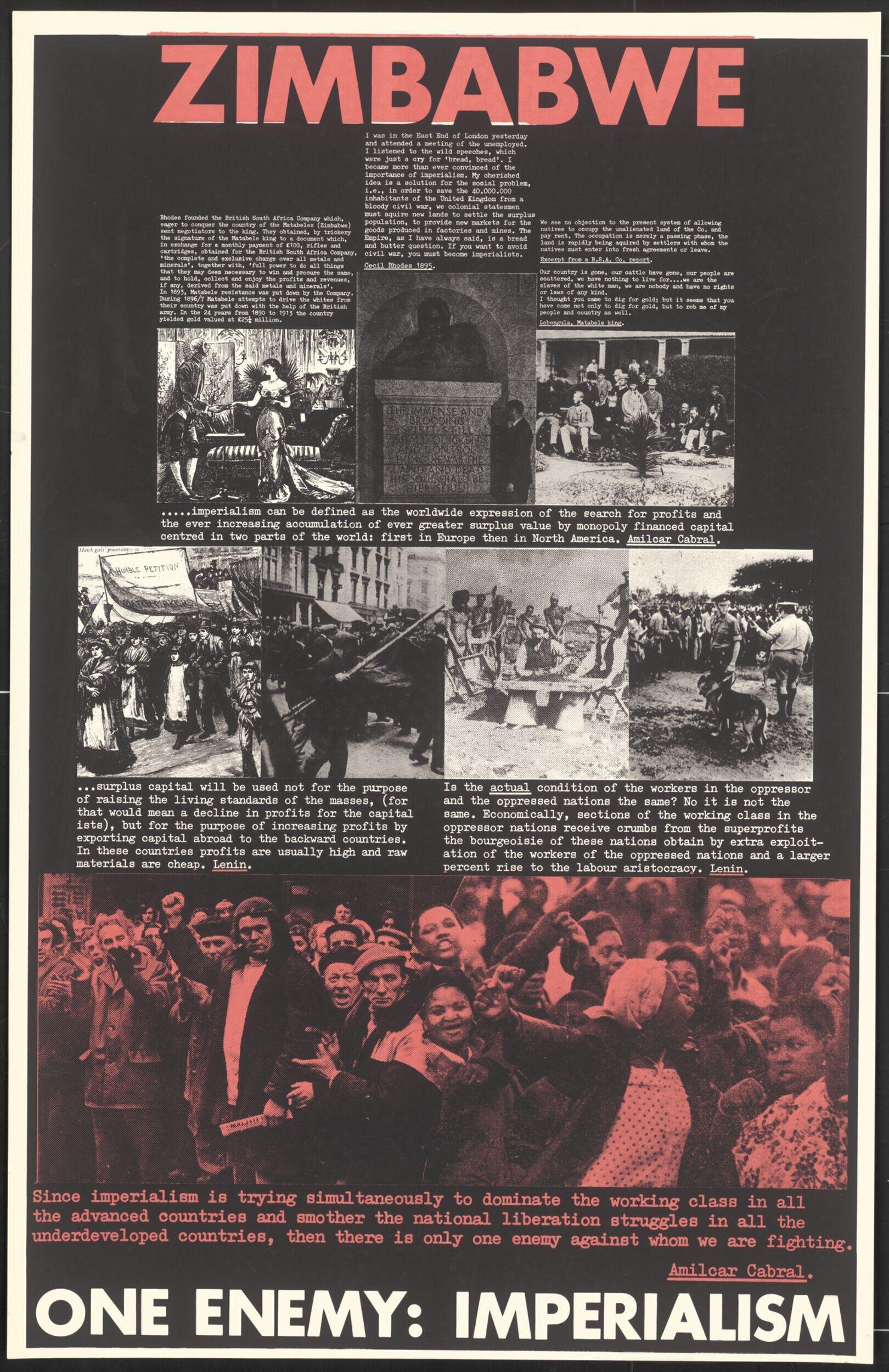
Zimbabwe: One Enemy: Imperialism, Grunwick Strike Committee, 1977, Poster
This poster, Zimbabwe: One Enemy: Imperialism (1977), offers a compelling example of how visual art functioned as a vital tool of resistance during the anti-colonial struggles in Zimbabwe, particularly in the late 20th century. Created during the height of Zimbabwe’s liberation movement against British colonial rule, the poster does more than merely inform; it also ignites passion. Through the strategic use of red ink and the layering of historical quotes and images, the poster becomes both an artifact of protest and a visual manifesto. The juxtaposition of colonial figures like Cecil Rhodes with quotes from revolutionary leaders such as Amílcar Cabral and Vladimir Lenin contextualizes imperialism as a multinational system of oppression, linking the struggle in Zimbabwe to broader global movements against colonialism and capitalism.
Art in this period was not simply decorative or commemorative, but often it was political. It served as a means of education, especially for populations with limited access to formal education or censored media. Posters like this circulated widely in liberation camps, townships, and urban centers, becoming accessible visual texts that challenged colonial narratives and affirmed Zimbabwean agency. The combination of text and imagery in this poster also reflects the influence of African modernism, which merged traditional aesthetics with contemporary political concerns. African modernist artists and designers used bold lines, limited color palettes, and stark contrast to create visuals that were both recognizable and emotionally charged. Moreover, the poster exemplifies how Zimbabwean resistance movements adapted and localized modernist art forms to work within their socio-political landscapes. While modernism in Europe often centered around formal experimentation, in colonial Zimbabwe it became deeply entwined with liberation politics. This poster, then, is not only a protest against imperialism, it is a declaration of cultural resistance.
Written by Emma Sapp
Gallery Associate