

“Statements of Nature
Pondering the planet at Glen Echo. Also: Vicky Perry’s flowers, Winston W. Harris’s cutouts, Irene Pantelis’s bark, Rob Pruitt’s pandas, Rick Ruggles’s closeups, and Michèle Colburn’s reprise
Mar 18, 2026
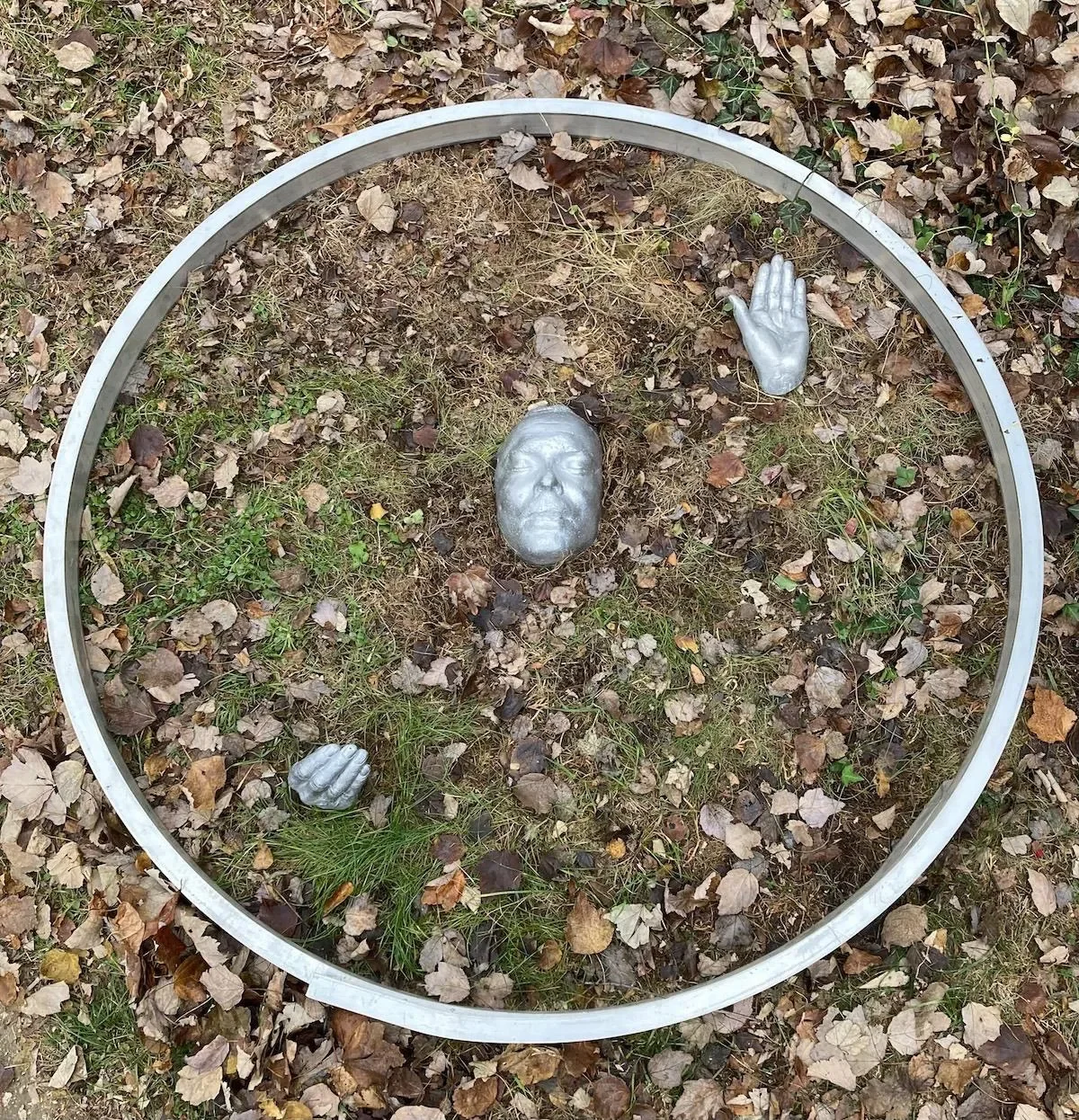
Esperanza Alzona, “Complacency” (Washington Sculptors Group)
ONLY FOUR OF THE 27 PIECES in “Critical Ground: Art and Environmental Justice” are outdoors, but all the entries in this Washington Sculptors Group show offer some perspective on the world outside manmade culture. This is reflected both in the subject matter and the materials of the exhibition, which is mostly in Glen Echo Park’s Popcorn Gallery. Many of the artworks are triumphs of recycling, whether the repurposed objects are the old instrument enclosure of Chris Combs’s tribute to Nevada’s near-extinct Pahrump poolfish or the colorful cardboard of “Octopus,” Joanathan Bessaci’s exuberant leap beyond his usual map-derived style.
The exemplary work is Esperanza Alzona’s “Complacency,” whose vision of a person almost contained by earth may be a little obvious conceptually, but is striking visually. Few of the pieces explicitly depict people, although a human torso lurks within Ira Tattelman’s found-object assemblage and small persons observe the black gush -- oil? -- at the center of Samuel Miller’s sculptural painting. Humanity is portrayed pungently, if less directly, in Sally Canzoneri’s paper model of D.C.’s main sewage pumping station, an ironic monument to civilization.
Among the elegantly stark offerings are Nicholas Femia’s steel “Legs,” which suggests a bodiless spider; Heidi Lippman’s formed-glass sculpture, charred to warn of global warming yet shimmeringly beautiful; Xiang Gu’s thicket of wooden stakes, which despite its denseness gives a pleasantly disorienting illusion of being weightless; and Miller’s “Funeral Urn for Planet Earth,” which conceals a twinkling night sky inside a giant ceramic vessel. Billy Friebele methodically arrays 3D prints of arrowheads to represent the erasure of local Native American culture, while David Whitmore conjures a sense of ancientness by contrasting mussel shells with fragments of industrial materials.
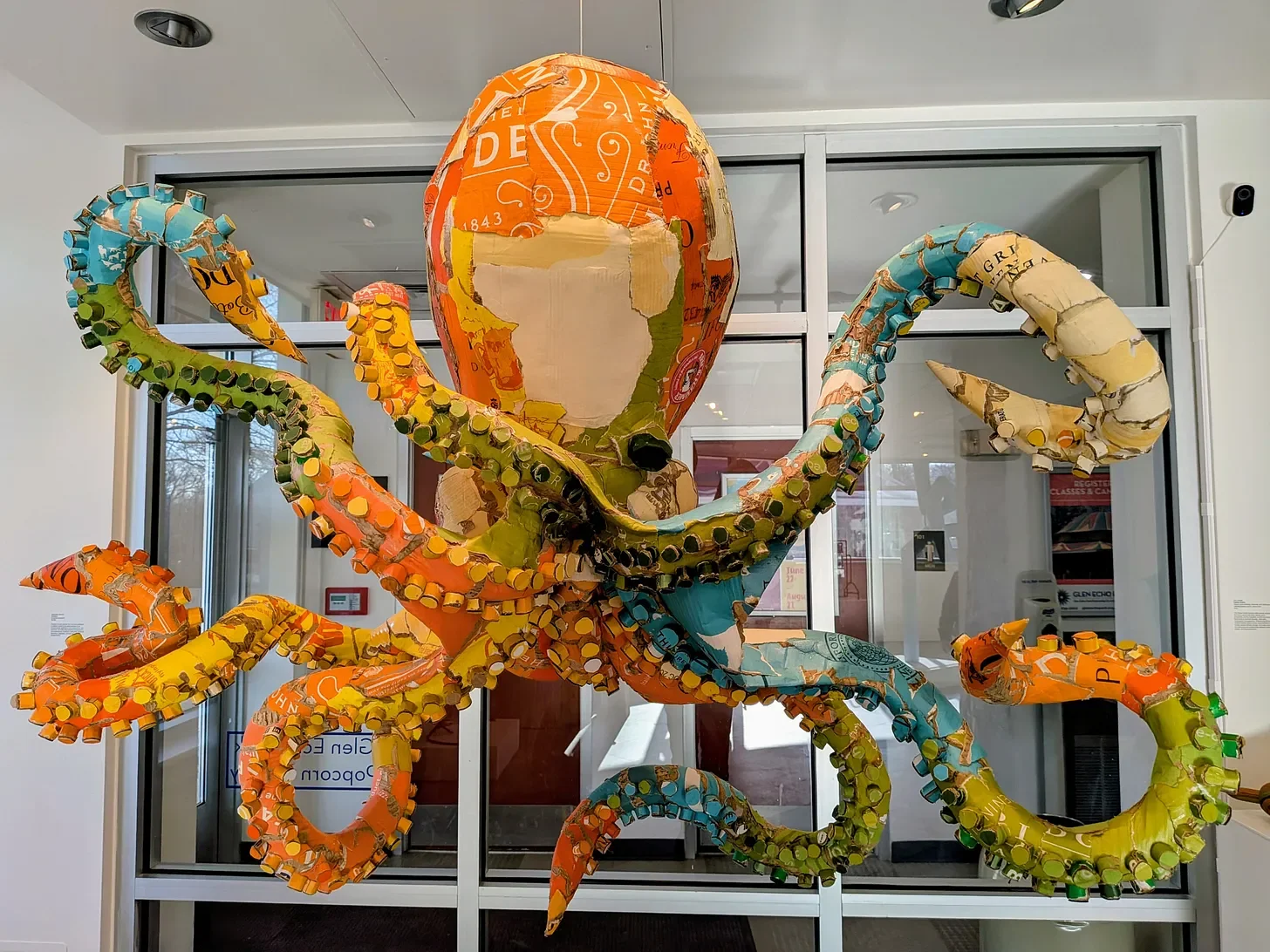
Joanathan Bessaci, “Octopus” (photo by Mark Jenkins)
Nature feeds on human detritus in Radhakund Ramnarine’s evocative sculptural collage, in which actual live plants grow from a spiral of deformed chairs. Birds flock to feeders in Marcie Wolf-Hubbard’s bas relief, made of paper mache and defined with charcoal and encaustic paint. In the context of this show, one of Jean Kim’s twisted-aluminum towers, sleekly machined, takes on an organic connotation.
Of the many entries that pit natural versus manufactured materials, the most urgent is McCleary Gallagher’s “Unsustainable”: A eight-foot-high metal spike impales a globe made of concentric wooden rings. As an environmental communique, this totem could hardly be more direct. Yet, like so many of the works in “Critical Ground,” it packs both complex resonance and visual grace.
At Glen Echo’s other galleries, Vicky Perry is showing photorealist floral paintings infiltrated by abstract touches, and Winston W. Harris is exhibiting color prints that often feature cutouts.
In her Stone Tower Gallery show, Perry foregrounds bright, precisely rendered blooms before complex, half-hidden backdrops. Flowers may dance across the sky in front of a massive waterfall, or rest next to a culture on which floral motifs are carved in stone. These playful juxtapositions are meant, according to the artist’s statement, to yield “a comprehensive unity.”
Harris’s prints, at Park View Gallery, are lively and colorful, with an art nouveau feel. Many of them are two-ply, with carved paper lattices mounted over the main image, but the most compelling depart the frame together. The artist’s set of twinned cutout horses, basically flat but bent to provide depth, is at once delicate and muscular.
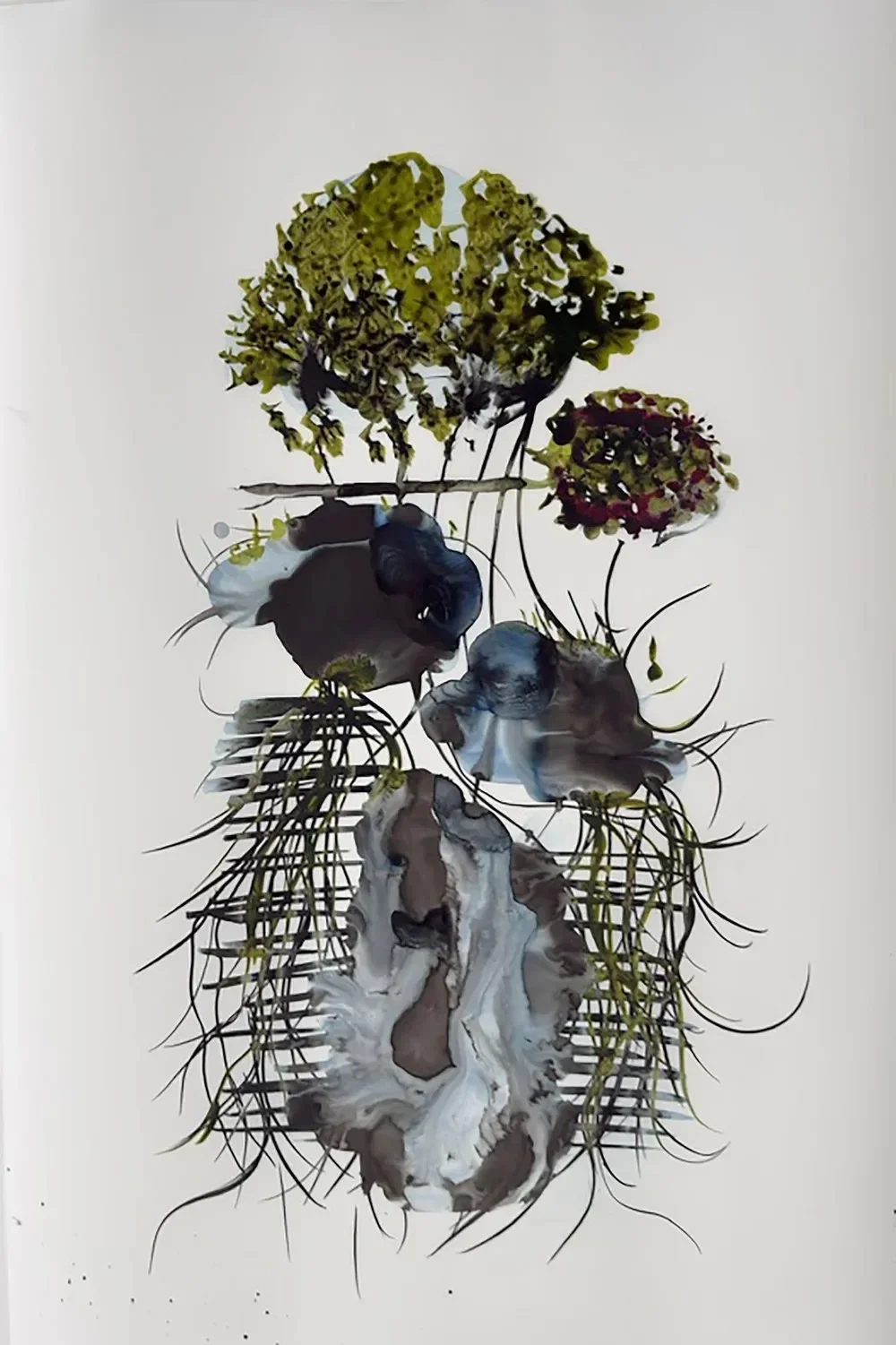
Irene Pantelis, “Protective Sheath” (Studio Gallery)
AT FIRST GLANCE, IRENE PANTELIS’S STUDIO GALLERY SHOW looks anything but autobiographical. The inspiration for her “Bitter Bark” seems to be botanical, but the mixed-media paintings appear more concerned with color, form, and texture than with representation. Made on non-absorbent Yupo paper, the pictures revel in how the ink, watercolor, and natural dyes pool, meld, and drip. The plant-like compositions, with leafy growth at top and cross-hatched roots below, could just be a way of complementing the pigments’s spontaneous movement.
In fact, the series stems from Pantelis’s unearthing of a photograph of her late father’s hometown in Bolivia. The tree in the picture is a cinchona, whose bark -- yes, it’s bitter -- yields quinine. As a treatment for malaria, quinine was once crucial for European colonizers in tropical climes. Pantelis conceived these fluid paintings to express “the circulation of bodies, plants, and medicines across geographies,” notes the show’s wall text.
The plant dyes, derived from cinchona trees, combine with the other pigments in color schemes that are often heavy on green and black, but sometimes feature intense pinks. The shrub-like trees do sometimes bear pink or red flowers, vivid plumage captured by such pictures as “Jesuit’s Bank” (a term for cinchona that recalls its colonial heritage). Positioned on empty white grounds so they look a bit like miniature planets, Pantelis’s cinchona trees blossom with an abundance that seems both earthy and other-worldly.
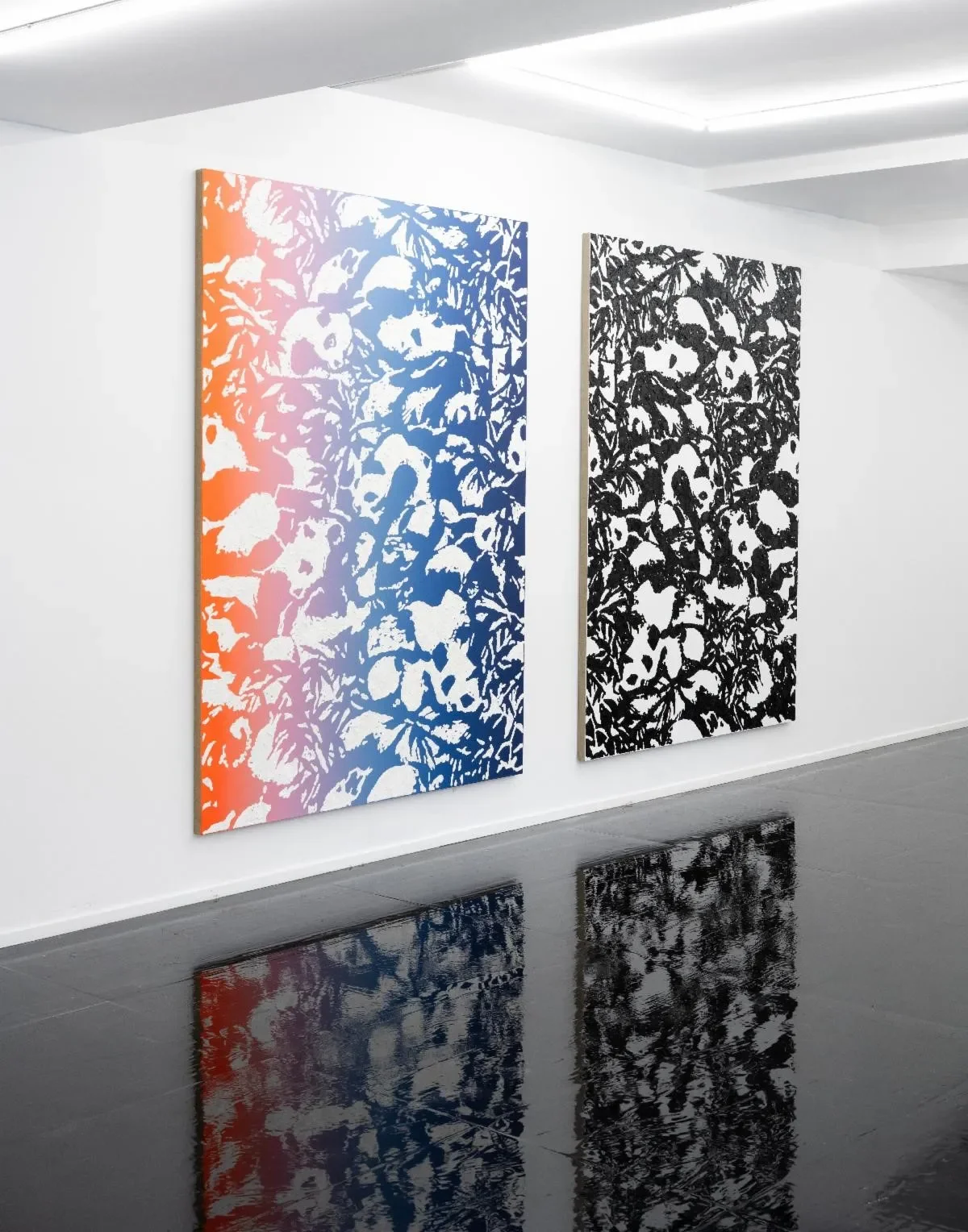
Installation shot of Rob Pruitt’s “Rob Wants to Make People Happy; He Aims to Please” (Von Ammon Co.)
ROB PRUITT IS PROBABLY BEST-KNOWN for “Cocaine Buffet,” a 1998 installation that offered a nearly 16-foot-long line of real coke to gallery goers. Just three years later, the Maryland-native New Yorker began painting glittery pandas, inspired in part by childhood trips to the National Zoo. The charismatic Chinese mammals are still among Pruitt’s subjects, as is demonstrated by his Von Ammon Co. show, “Rob Wants to Make People Happy; He Aims to Please.” This title, if not purely ironic, is certainly equivocal.
With one exception, the 28 panda vignettes in this set are monochromatic, like the creatures themselves. Rendered with black-acrylic outlines on white paper, the pictures look more like prints than paintings. They all seem of a piece, but the compositions were generated by AI, which “has been fed the seminal works of various high-achievers of art history and contemporary art ... to be mutated crudely into Panda scenes,” according to the gallery’s essay. This provenance is not obvious from the results, which are quite similar in style.
Pandas, of course, are not really as cuddly as they appear. Yet Pruitt doesn’t give his animals a sense of menace, even though threatening demeanors are quite common in Von Ammon shows. In the most provocative picture, two pandas carry placards, as if involved in some sort of protest. But the signboards are blank, so the mammals’s stance is unclear. Are they MAGA? Antifa? Or commercial pitch-bears? That ambiguity is crucial. Pandas are almost universally beloved. But they don’t exist to make people happy, any more than any natural phenomena does.
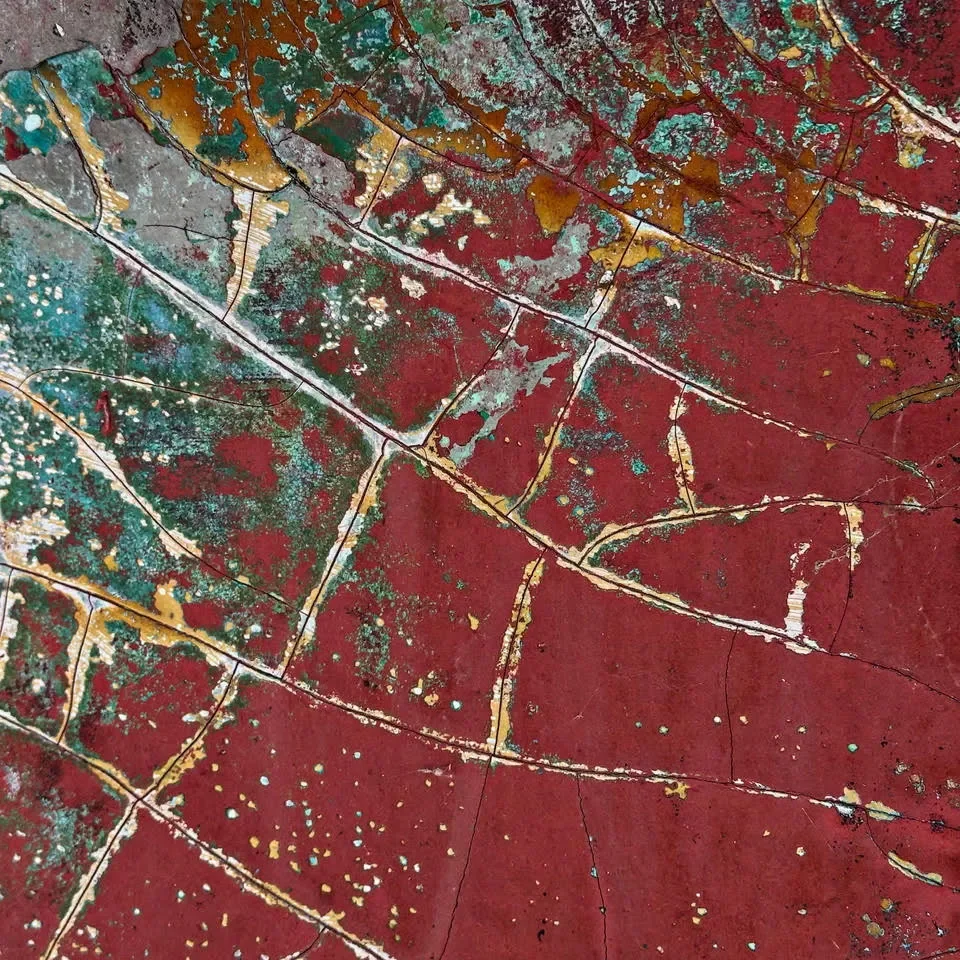
Rick Ruggles, “Pending” (courtesy of the artist)
RICK RUGGLES CLEARLY LOVES METAL, so it’s no great surprise to learn that the photographer was “a metalsmith for many years,” according to the bio for his Artists & Makers exhibition. The pictures in “Focus Pocus: Macrophotography” include several views of voluptuously oxidized surfaces. One ruggedly lovely photo depicts rust-tinged yellow and orange drips etched on bluish metal, a visual essay on elegant deterioration. Even a closeup of a leaf is primarily in metallic yellow and brown hues, with just a tinge of green along the veins.
All the pictures in this selection are square, and some may have been made with a macro lens. But some clearly weren’t. Amid the tightly framed photos of tiny found patterns, mostly unrecognizable but pictorially irrefutable, are such playful non-macro vignettes as a street divided by a painted yellow line in which one segment, painted on a manhole cover, has become misaligned. The world Ruggles observes can appear perfect, or comically off-kilter.
Lest the photographer’s eye for beautifully battered colors completely upstage his compositional flair, the show includes five black-and-white pictures. Seemingly depicting the play of light on hair, “White Tornado” offers an epic contrast between shadow and illumination. It’s a reminder that Ruggles, like all photographers, is on a quest for immaculate light.
AT THE ARTS CLUB OF WASHINGTON, Michèle Colburn is showing many of pigment-and-gunpowder pictures she recently exhibited at George Mason University’s Arlington campus. For a review of that show, see discerningeye.substack.com/p/a-forest-of-details
Washington Sculptors Group: Critical Ground: Art and Environmental Justice
Through March 22 at Popcorn Gallery and outdoors.
Vicky Perry: Secret Life of Flowers
Through March 22 at Stone Tower Gallery.
Winston W. Harris: New Everything, New
Through March 21 at Park View Gallery.
All at Glen Echo Park, 7300 MacArthur Blvd., Glen Echo. glenechopark.org/partnershipgalleries. 301-634-2222.
Irene Pantelis: Bitter Bark
Through March 21 at Studio Gallery, 2108 R St. NW. studiogallerydc.com. 202-232-8734.
Rob Pruitt: Rob Wants to Make People Happy; He Aims to Please
Through March 23 at Von Ammon Co., 3210 Grace St. NW. vonammon.co.
Rick Ruggles: Focus Pocus: Macrophotography
Through March 25 at Artists & Makers, 11810 Parklawn Dr., Rockville. artistsandmakersstudios.com. 240-437-9573.
Michèle Colburn
Through March 28 at the Arts Club of Washington, 2017 I St. NW. artsclubofwashington.org. 202-331-7282.”
Written by Mark Jenkins in DisCerning Eye, thank you!